
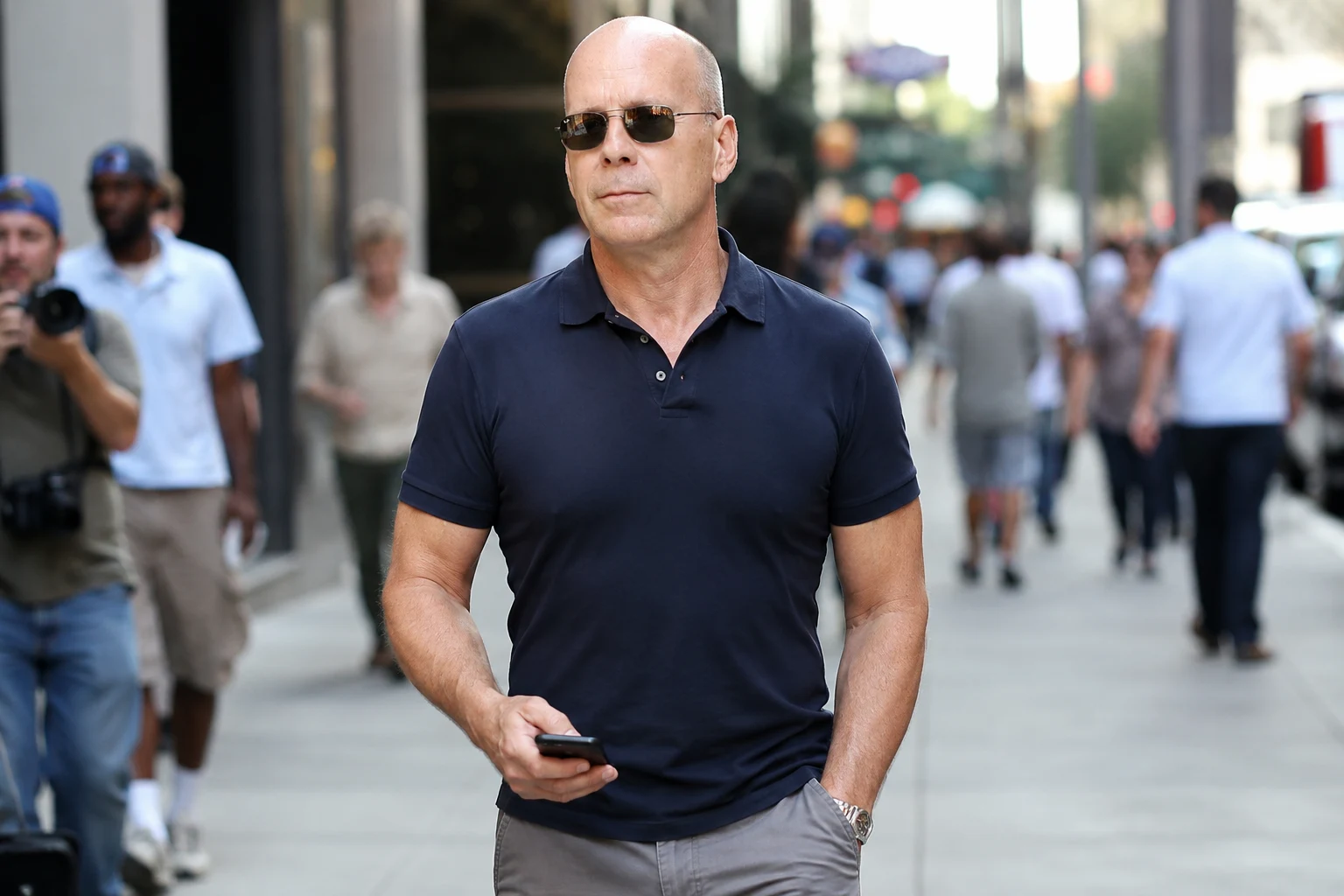
Bruce Willis is one of Hollywood’s most recognizable actors, best known for turning the wisecracking New York cop John McClane in Die Hard into one of cinema’s defining action heroes. But his career has never been limited to action films. From the television success of Moonlighting to acclaimed appearances in Pulp Fiction, The Sixth Sense, 12 Monkeys, Unbreakable and Looper, Willis built a career that crossed comedy, drama, science fiction and crime.
Born in 1955, Willis became a major star during the late 1980s and remained a familiar presence on screen for decades. He has also earned major television honors, including an Emmy for Moonlighting and a Golden Globe for the same series.
In recent years, however, public attention has shifted from his film career to his health and family life. His family first announced an aphasia diagnosis in 2022 and later confirmed that he had frontotemporal dementia (FTD). As of 2026, his family continues to emphasize connection, dignity and support while he lives with the condition.
Who Is Bruce Willis? A Short Biography
| Category | Details |
|---|---|
| Full Name | Walter Bruce Willis |
| Date of Birth | March 19, 1955 |
| Age | 71 |
| Birthplace | West Germany |
| Nationality | American |
| Profession | Actor, producer |
| Years Active | 1970s–2020s |
| Education | Penns Grove High School |
| Famous For | Die Hard, Moonlighting, Pulp Fiction, The Sixth Sense |
| Father | David Willis |
| Mother | Marlene Willis |
| Marital Status | Married |
| Spouse / Partner | Emma Heming Willis |
| Children | Five daughters |
| Source of Income | Acting and film-related work |
Willis was born in what was then West Germany and grew up in New Jersey. His early years in New Jersey became part of the public image associated with him, particularly as his performances developed a recognizable mixture of humor, toughness and understated charm.
Early Life and the Road to Acting
Before becoming a Hollywood star, Willis pursued acting and performed in theater productions. His breakthrough came through television rather than film, when he was cast as private investigator David Addison Jr. in Moonlighting. The series paired him with Cybill Shepherd and gave Willis an opportunity to demonstrate comic timing, improvisational energy and dramatic presence.
That combination proved important. Rather than being introduced to audiences simply as an action performer, Willis arrived as a charismatic television actor who could move comfortably between humor and drama. Moonlighting ran from 1985 to 1989 and established him as a major entertainment figure.
Moonlighting Made Him a Television Star
Moonlighting was more than a stepping stone to film. It became one of the most important early achievements of Willis’s career. His portrayal of David Addison earned him a Primetime Emmy Award for Outstanding Lead Actor in a Drama Series in 1987. He had also been nominated in the same category in 1986.
The Golden Globes also recognized his work. Willis won the 1987 Golden Globe for Best Performance by an Actor in a Television Series, Musical or Comedy, while Moonlighting remained one of the defining television successes of the period.
Bruce Willis and the Rise of the Die Hard Franchise
How Die Hard Changed His Career
The defining turning point arrived in 1988 with Die Hard. Willis played John McClane, an ordinary New York police officer caught in a terrorist takeover of a Los Angeles skyscraper. The character was different from the seemingly invincible action heroes who dominated many films of the era.
McClane was vulnerable, sarcastic and frequently exhausted. That vulnerability helped make the character relatable, while Willis’s comic delivery gave the film a personality that separated it from conventional action movies. Die Hard became a major success and established Willis as one of Hollywood’s leading movie stars.
Building an Action-Movie Legacy
The success of Die Hard produced four sequels: Die Hard 2 in 1990, Die Hard with a Vengeance in 1995, Live Free or Die Hard in 2007 and A Good Day to Die Hard in 2013. Across the franchise, Willis repeatedly returned to the role that had transformed his career.
John McClane ultimately became inseparable from Willis’s public identity. Yet his career after the first Die Hard demonstrated that he did not want to remain confined to one genre. He repeatedly accepted projects that allowed him to explore different kinds of characters and filmmakers.
Beyond Action: Pulp Fiction, 12 Monkeys and The Sixth Sense
One of Willis’s most important career choices came with Quentin Tarantino’s Pulp Fiction in 1994. The film placed him within an ensemble cast and showed a different side of his screen persona. He followed it with Terry Gilliam’s science-fiction thriller 12 Monkeys in 1995.
In 1999, Willis appeared in M. Night Shyamalan’s The Sixth Sense, a psychological thriller that became a major critical and commercial success. He later worked with Shyamalan again in Unbreakable and returned to the filmmaker’s universe years later in Glass. His filmography also includes Armageddon, Looper, Red and Red 2.
Bruce Willis’s Best-Known Movies and Performances
Die Hard and John McClane
For many moviegoers, Die Hard remains the definitive Bruce Willis film. Its influence can be seen in the modern action genre, particularly in the popularity of reluctant or vulnerable protagonists. Willis’s performance helped make John McClane feel like a person rather than simply an action-machine character.
The film also demonstrated why Willis was particularly effective in high-pressure roles. His performance combined physical action with humor, frustration and emotional vulnerability. That balance became one of the actor’s most recognizable trademarks.
Pulp Fiction and a Different Kind of Willis Performance
Willis’s appearance in Pulp Fiction was significant because it placed an established mainstream star inside Tarantino’s unconventional storytelling style. His character, Butch Coolidge, is a professional boxer caught between violence, loyalty and personal survival.
The role allowed Willis to work against the expectations created by Die Hard. Instead of relying primarily on wisecracks and action spectacle, the performance depended on tension and character choices. It remains one of the strongest examples of Willis working within an ensemble-driven crime film.
The Sixth Sense, Unbreakable and Looper
Willis’s collaboration with M. Night Shyamalan produced some of his most restrained performances. In The Sixth Sense, he played Malcolm Crowe, a psychologist whose relationship with a young boy forms the emotional center of the story. The film received an Academy Award nomination for Best Picture and became a landmark in late-1990s psychological horror.
He later appeared as David Dunn in Unbreakable, a more introspective superhero story, and reprised the character in Glass. Another notable late-career science-fiction role came in Looper, where he shared the screen with Joseph Gordon-Levitt and Emily Blunt.
Bruce Willis’s Awards and Achievements
Emmy and Golden Globe Recognition
Willis’s awards history reflects the fact that his success began on television before he became a movie icon. The Television Academy records his 1987 Emmy win for Outstanding Lead Actor in a Drama Series for Moonlighting. He had been nominated in the same category the previous year.
His Golden Globe recognition came in 1987, when he won for his performance in Moonlighting. The Golden Globes database lists multiple nominations for Willis and documents his win as one of the major milestones of his early career.
A Career That Crossed Genres
The breadth of Willis’s filmography is one of his most significant achievements. He could headline large-scale action films, appear in unconventional independent or ensemble projects, and take dramatic roles that required a quieter screen presence.
His collaborations with directors including Quentin Tarantino, Terry Gilliam, M. Night Shyamalan and Wes Anderson illustrate that range. The Golden Globes’ retrospective on his career specifically highlights his work across multiple genres and with filmmakers whose styles were dramatically different from one another.
Why His Screen Persona Endures
Willis’s influence comes partly from the fact that his characters often felt accessible. John McClane was not portrayed as an untouchable superhero. His humor often appeared at the worst possible moment, and his characters frequently seemed to improvise their way through danger.
That combination helped shape the modern action protagonist. Even when Willis was playing a character surrounded by extraordinary circumstances, he frequently brought an everyday quality to the performance. It is one reason his work continues to be associated with the evolution of the action genre.
Bruce Willis, Family and Personal Life
Marriage to Demi Moore
Willis married actress Demi Moore in 1987, and the couple became one of Hollywood’s most visible celebrity pairs. They had three daughters together: Rumer, Scout and Tallulah. Willis and Moore divorced in 2000, but they continued to maintain a family relationship centered around their children.
Their approach to family life became especially notable after Willis’s health problems became public. Moore and the three daughters have remained part of the broader support network around him, alongside his current wife and their children.
Marriage to Emma Heming Willis
Willis married model and entrepreneur Emma Heming Willis in 2009. They have two daughters, Mabel Ray and Evelyn Penn, bringing Willis’s total number of daughters to five.
In recent years, Emma Heming Willis has become an important public voice on caregiving and frontotemporal dementia. She has spoken openly about the practical and emotional challenges of caring for someone with FTD while raising two young children.
A Blended Family Supporting Him
Willis’s family has remained notably united through his health challenges. His five daughters, Emma Heming Willis and Demi Moore have all publicly expressed support for him at different times.
That family dynamic has become an important part of the later chapter of Willis’s life. Rather than focusing exclusively on his former celebrity status, his family’s public comments have increasingly centered on maintaining meaningful connections and protecting his dignity.
Bruce Willis’s Health and Latest Updates
Aphasia Diagnosis and Retirement From Acting
In 2022, Willis’s family announced that he had been diagnosed with aphasia and would step away from acting. The condition was affecting his cognitive abilities and, particularly, his communication. At the time, the family said the decision to end his career was a difficult one.
The announcement marked a major change for an actor who had spent decades working continuously in film and television. His final years as a working actor were especially prolific, with a large number of direct-to-video and streaming-era releases, but his family ultimately prioritized his health.
Frontotemporal Dementia Diagnosis
In February 2023, the family announced that Willis’s condition had progressed and that he had received a more specific diagnosis of frontotemporal dementia, commonly known as FTD. The diagnosis helped explain the communication difficulties that had initially been described as aphasia.
FTD is a form of dementia associated with changes affecting areas of the brain involved in language, personality and behavior. Unlike the public image of dementia often associated with memory loss, FTD can prominently affect communication and behavior.
His Family’s 2025–2026 Updates
Emma Heming Willis has continued to speak publicly about caregiving. In 2025, she explained that the family had arranged a separate nearby home for Bruce that could better accommodate his care needs while allowing their two younger daughters to maintain a stable childhood environment. She emphasized that every caregiving situation is different and that the family made the decision around safety and well-being.
In May 2026, Rumer Willis offered another update, describing her father as “OK” within the reality of his condition and emphasizing the continuing connection between him and his family.
More recently, Willis was present for his daughter Tallulah Willis’s wedding to musician Justin Acee in August 2026, according to coverage of the family celebration. Photos from the event showed a tender family moment involving the actor and his daughter.
Frequently Asked Questions About Bruce Willis
Q: How old is Bruce Willis?
A: Bruce Willis was born on March 19, 1955. He turned 71 in March 2026. He was born in what was then West Germany and grew up in New Jersey.
Q: What is Bruce Willis best known for?
A: He is best known for playing John McClane in the Die Hard franchise. He is also widely recognized for Moonlighting, Pulp Fiction, The Sixth Sense, Unbreakable, 12 Monkeys, Armageddon and Looper.
Q: Why did Bruce Willis stop acting?
A: Willis stepped away from acting after his family announced an aphasia diagnosis in 2022. In 2023, his family revealed that his condition had progressed to frontotemporal dementia, or FTD.
Q: How many children does Bruce Willis have?
A: Bruce Willis has five daughters. Three, Rumer, Scout and Tallulah, are from his marriage to Demi Moore, while Mabel Ray and Evelyn Penn are from his marriage to Emma Heming Willis.
Q: What happened to Bruce Willis’s health?
A: His family first disclosed that he had aphasia in 2022 and later announced a diagnosis of frontotemporal dementia in February 2023. His family has continued to support him while raising awareness about FTD and the challenges faced by caregivers.
Conclusion
Bruce Willis’s career is defined by much more than the Die Hard franchise. He emerged from Moonlighting as a television star, became an international movie icon with John McClane, and then demonstrated remarkable range through films such as Pulp Fiction, 12 Monkeys, The Sixth Sense, Unbreakable and Looper. His Emmy and Golden Globe victories further established that his talent extended well beyond action cinema.
Today, the most important chapter of his story is centered on family. Following his aphasia diagnosis and later frontotemporal dementia diagnosis, his loved ones have remained closely involved in his care and have helped bring greater public awareness to FTD. His legacy remains firmly established in film, while his family continues to emphasize the person behind the Hollywood icon.
Read About : bebe rexha